




Calgary is one of Canada’s most culturally diverse major cities. According to the 2021 Statistics Canada Census, 41% of residents identified as a visible minority, up from 36% in 2016. The 2021 census also found that first- and second-generation Canadians make up 6 in 10 Calgarians. Calgary’s diversity is most concentrated in the northeast quadrant of the city, where a cluster of communities, including Cornerstone, Saddle Ridge, and Martindale, has become home to large South Asian, Filipino, East African, and Arab populations. The International Avenue corridor in Forest Lawn serves as one of the city’s dedicated multicultural commercial and cultural districts.
For homebuyers looking for a culturally diverse Calgary neighbourhood, these communities offer a range of housing options, amenity access, schools, and transit connections worth knowing before you choose where to build or buy.
TL;DR
- Calgary is one of Canada’s most culturally diverse major cities, with 41% of residents identifying as a visible minority and first- and second-generation immigrants making up 6 in 10 Calgarians.
- The most culturally diverse communities in Calgary include Cornerstone, Saddle Ridge, and Martindale in the northeast, as well as the International Avenue corridor in Forest Lawn in the southeast.
- When comparing communities, homebuyers should consider housing mix and home type, amenity access, school catchment boundaries, and transit connections before making a decision.
What Makes Calgary a Diverse City?
Calgary’s diversity is the product of sustained immigration over several decades. The City of Calgary reports that 41% of residents identified as a visible minority in 2021, up 5 percentage points from 2016. According to Statistics Canada’s 2021 Census, the largest racialized groups in the Calgary metropolitan area are South Asian (approximately 153,200 people, representing 10.5% of the population), Chinese (93,510, 6.4%), and Filipino (89,050, 6.1%). The Philippines, India, and China are the top countries of origin for immigrants citywide.
Calgary is home to more than 240 ethnic origins and 165 languages. The most widely spoken non-official languages are Tagalog, Punjabi, Cantonese, Mandarin, and Spanish.
Calgary Neighbourhoods with Diverse Populations
Calgary’s most culturally diverse communities are concentrated in the northeast. Cornerstone is a newer master-planned community with one of the highest shares of immigrants in the city. Saddle Ridge is an established neighbourhood with a large and well-served South Asian community. Martindale is home to one of Calgary’s most prominent Sikh cultural institutions. In southeast Calgary, the International Avenue corridor in Forest Lawn is a 35-block multicultural commercial strip with over 430 businesses representing cultural origins from around the world.
Cornerstone
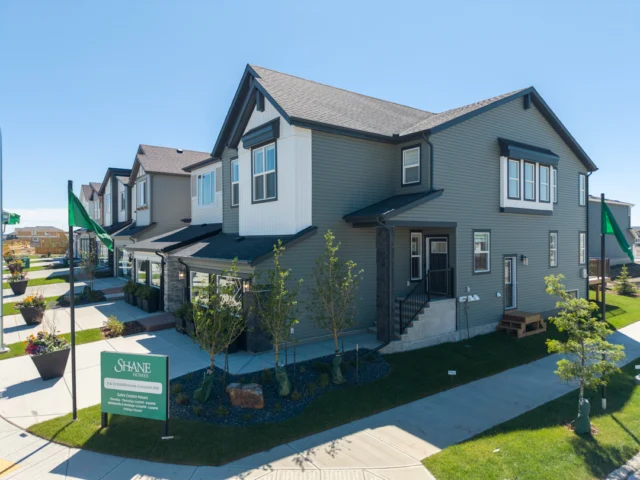
Cornerstone is a master-planned community in northeast Calgary spanning over 1,100 acres, and is one of the most demographically diverse newer communities in the city. According to the City of Calgary’s 2021 Census community profile, 92% of Cornerstone residents identify as a visible minority (compared to 41% citywide), 61% are immigrants (compared to 33% citywide), and 59% are of South Asian background. The top countries of origin for immigrant residents are India (53%), the Philippines (15%), and Pakistan (8%). Punjabi is the first language of 34% of residents, and 50% speak a non-official language most often at home.
Cornerstone’s amenity mix reflects the community’s diverse residents. The community’s Highstreet retail area includes a Chalo! FreshCo, a Shoppers Drug Mart, and a cricket pitch alongside seven playgrounds and 14 kilometres of walking paths through 180 acres of natural wetlands. Residents have five access points to Stoney Trail, Country Hills Boulevard, and Airport Trail, with the Saddletowne CTrain station a short drive away.
Saddle Ridge
Saddle Ridge is one of Calgary’s most established diverse communities in the northeast, with 62% of residents identifying as immigrants according to Statistics Canada’s 2021 Census. The community has a predominantly South Asian population, with South Asian restaurants, grocery stores, and retail concentrated along Saddletowne Circle and surrounding commercial areas.
Saddle Ridge sits adjacent to the Saddletowne CTrain station, giving residents direct LRT access to downtown Calgary and other parts of the city. The Genesis Centre is a 225,000-square-foot community hub that includes a YMCA, Calgary Public Library branch, and recreational programming. It serves approximately two million visitors annually and received the 2020 Calgary Chamber of Commerce TD Inclusion & Diversity Award.
Housing in Saddle Ridge is primarily single-family detached and semi-detached, offering a range of options for families at different price points.
Martindale
Martindale is a well-established northeast community with 55% of residents identifying as immigrants in 2021. It has a large South Asian population and is home to the Dashmesh Culture Centre, one of Calgary’s most prominent Sikh cultural and community institutions.
Residents have access to the Genesis Centre, Martindale CTrain station on the Blue Line, and the established commercial corridors of the broader northeast quadrant. The community has an active community association and a mix of single-family detached and semi-detached housing. Martindale is surrounded by similarly diverse communities, including Taradale to the east, Saddle Ridge to the north, and Rundle and Temple to the west and south.
International Avenue and Forest Lawn
International Avenue refers to the 35-block commercial strip along 17 Ave SE in the Forest Lawn area of southeast Calgary. Established as a Business Revitalization Zone in 1993, it is home to more than 430 businesses representing cultural origins from around the world. Since 2001, the International Avenue mural programme has produced 12 large murals along the strip, each dedicated to a cultural community represented in the area, including Portuguese, Vietnamese, Caribbean, Arabic, East African, Italian, Indigenous, and Indo-Canadian communities. The area draws residents and visitors from across Calgary seeking international grocery stores, restaurants, and specialty shops that are hard to find elsewhere in the city.
The surrounding Forest Lawn neighbourhood reports that 31% of its residents are immigrants and 27% speak a non-official language at home, according to the City of Calgary. The area is served by the MAX Purple rapid transit route, which connects International Avenue directly to downtown Calgary and East Hills.
What to Look for in a Calgary Neighbourhood
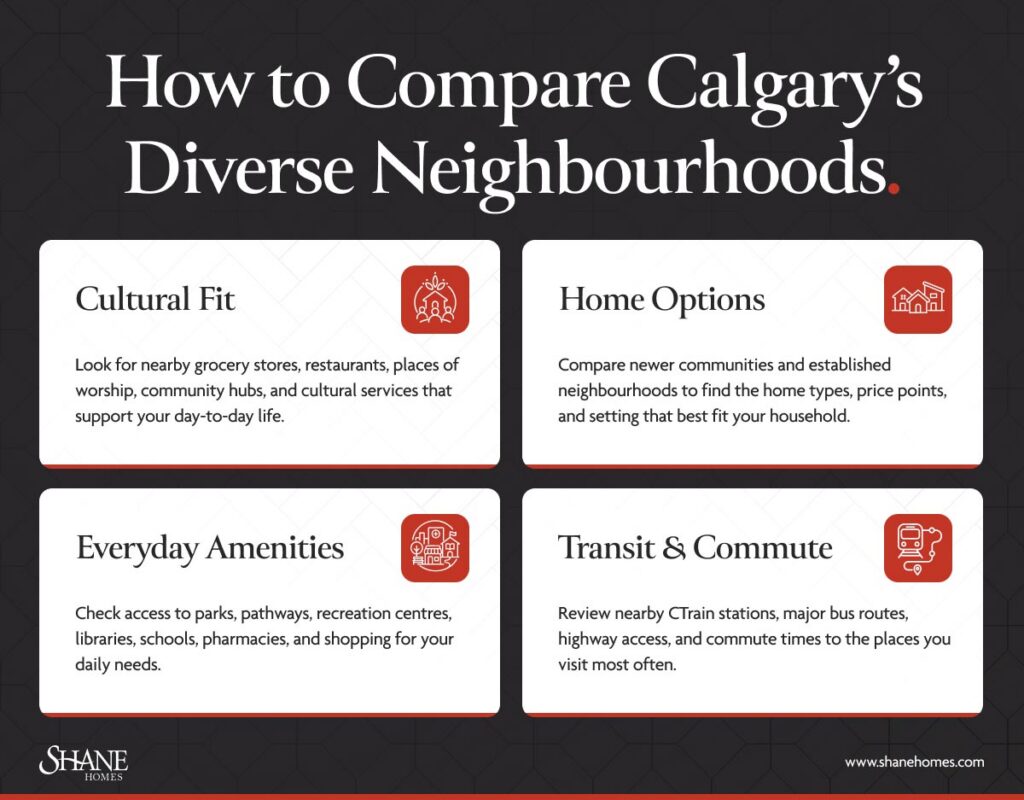
In addition to finding a neighbourhood that’s a cultural fit, homebuyers comparing communities should consider practical factors including the housing mix, nearby amenities, designated schools, and transit access. The right community should offer home types that fit your household size, budget, and lifestyle, as well as everyday amenities such as grocery stores, recreation options, places of worship, parks, and community services. Because Calgary school assignments are based on address, buyers should also verify catchment boundaries before purchasing. Transit access, especially proximity to CTrain stations and major bus routes, is also an important consideration for newcomers and commuters.
Housing Mix and Home Type
Calgary’s newer communities offer front-drive homes, laned homes, duplexes, and townhomes built by various homebuilders, including Shane Homes. Established communities typically offer resale detached and semi-detached housing. The right home type depends on your household size, budget, and how much outdoor and garage space matters to you. Knowing which type suits your household before you start visiting communities can help save time.
Amenity Access
Homebuyers should consider whether the community offers the amenities their household will use, such as recreational facilities, a community centre, a library branch, grocery and retail options, places of worship, and parks.
Schools
School catchment boundaries in Calgary are assigned by address, not by community name. Verify the designated school for any home you are considering before purchasing. The Calgary Board of Education and the Calgary Catholic School District both publish searchable school finder tools online. Community association websites are also a useful resource for understanding local schooling options.
Transit and Commute
Calgary’s transit network includes the CTrain LRT system and an extensive bus network covering communities across all four quadrants. For homebuyers who rely on public transit, check the proximity of your chosen community to CTrain stations and major bus routes before committing to a home. Calgary Transit’s trip planner is a useful resource for understanding how well a specific address is connected to the rest of the city.
Build in a Calgary Community That Fits Your Life
Calgary has a wide range of communities suited to homebuyers from all backgrounds. The right fit depends on your household, your priorities, and what day-to-day life looks like for your family. Whether you are drawn to an established neighbourhood or a newer community, cultural amenities, transit access, and housing variety can be found across the city.
Shane Homes has been building homes across Calgary for over 45 years and builds in Cornerstone, one of the city’s most culturally diverse newer communities. For homebuyers navigating the process for the first time, Shane Homes offers verbal translation services in 85 languages and purchase agreements in Hindi and Punjabi to provide clear guidance at every step. Visit a Shane Homes showhome to speak with an Area Manager, or use the Build and Price tool to explore home models and floor plans.
Frequently Asked Questions
What is the most multicultural area in Calgary?
Northeast Calgary is the most culturally diverse area of the city. Communities including Saddle Ridge, Martindale, Redstone, Skyview Ranch, and Cornerstone all report immigrant populations of 55% to 63%, roughly double the citywide average of 33%. International Avenue on 17 Ave SE in Forest Lawn is Calgary’s primary multicultural commercial corridor, with over 430 businesses representing cultural origins from around the world.
What languages are most commonly spoken in Calgary?
English is the primary language across the city. The most widely spoken non-official languages in Calgary are Tagalog, Punjabi, Cantonese, Mandarin, and Spanish, according to Statistics Canada’s 2021 Census. In northeast Calgary communities with large South Asian populations, Punjabi is particularly prominent. In Cornerstone, for example, Punjabi is the mother tongue of 34% of residents.
What is the best Calgary community for newcomers to Canada?
Northeast Calgary offers the most established infrastructure for newcomers, including cultural amenities, places of worship, settlement services, and LRT access via multiple CTrain stations. Among newer communities, Cornerstone has a notable diverse demographic profile with 61% of residents identifying as immigrants and 92% as a visible minority. The community also offers a practical amenity mix, including a Chalo! FreshCo grocery store, a cricket pitch, and a range of new-build home types.
Can newcomers to Canada build a new home in Calgary?
Yes. Newcomers to Canada can build a new home in Calgary with Shane Homes. The process generally involves choosing a community and home type, working with an Area Manager to select a lot and floor plan, and securing financing through a Canadian lender. Financing options and eligibility will vary depending on individual circumstances, so speaking with a mortgage professional early in the process is recommended.
For homebuyers interested in building in a diverse northeast community, Shane Homes builds in Cornerstone, where Area Managers are available to walk buyers through the full process from lot selection through to possession. Shane Homes also offers verbal translation services in 85 languages and purchase agreements available in Hindi and Punjabi, making the process more accessible for homebuyers who are more comfortable working in their first language.